
By Ginny Gaylor
Public Ed Works
“I know no safe depository of the ultimate powers of the society but the people themselves, (A)nd if we think them not enlightened enough to exercise their control with a wholesome discretion, the remedy is not to take it from them, but to inform their discretion by education. This is the true corrective of abuses of constitutional power.” — Thomas Jefferson
Despite not being mentioned directly in the U.S. constitution, there can be no doubt how much our founding fathers valued education. And with the establishment of America as an independent nation, the need for and recognition of the importance of education grew.
Not only did our founding fathers find education to be vitally important, they also played significant roles in creating institutions of higher learning. Thomas Jefferson and Benjamin Franklin, among others, were directly involved in the creation of a college or academic institution.
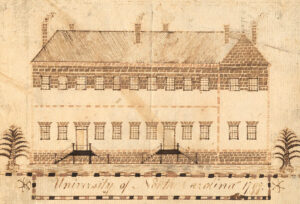
In the span of 20 years (1782-1802), 19 colleges that still exist today were chartered in the newly established United States of America. Among these was the University of North Carolina at Chapel Hill, chartered in 1789 and opening its doors in 1795.
Enlightening citizens
George Washington, in a letter to Alexander Hamilton, described a proper education “as one of the surest means of enlightening and giving just ways of thinking to our citizens.” The question then, is what would these same founding fathers, many of whom wanted to establish a national university, think of our public education system today?
The founders recognized that America was built on the foundation of a diverse population and bringing those citizens together and unifying them was how our nation could live and govern together. They also recognized that an uneducated public would be vulnerable to manipulation and tyranny.
Public schools became places where students learned not only the basics of reading, writing and mathematics, but also the principles and responsibilities of citizenship. We make no claim that public education is perfect. American history has too many stories of unequal educational opportunity.
But throughout it all, we have aspired as a nation to expand access to education, allowing each generation a greater opportunity to participate fully in American democracy. This progress has often come through efforts to make public education more inclusive, equitable and effective—not by abandoning the institution itself.
Public education in crisis
Today, public education across the nation and in the state of North Carolina is in crisis due to chronic underfunding, increasing political polarization, teacher shortages, attacks on educators’ professional expertise, widening disparities between communities and declining trust in public institutions.
The reality is that when schools lack the resources to provide high-quality education, the effects extend well beyond the classroom.
A democracy depends on citizens who can distinguish evidence from misinformation, evaluate competing claims, understand the rights and responsibilities of citizenship and engage constructively with people who hold different views. When public education is weakened, our democracy suffers as a result.
As we look both back at our country’s first 250 years of democracy, and consider what the next 250 years hold, it is vital that we refocus our attention on strengthening education in our state and nation. The erosion of public education is not merely an educational concern, it is a democratic one as well.
If we want to foster a shared understanding of democratic values while respecting individual differences, we must instill in future generations the knowledge, critical thinking skills and civic commitment necessary to protect and strengthen the democratic institutions they inherit.
Leave a Reply