
CHAPEL HILL (March 11, 2026) – The proposed relocation of the Dean Dome to “Carolina North” seems to have hijacked the conversation into areas unrelated to the mission of a university.
The outcry has drowned out another option the administration presented for the use of that land: An academic anchor in applied sciences.
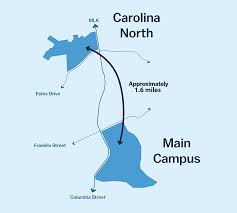
Carolina North is the name given to the 230-acre segment of a 950-acre tract deeded to UNC-Chapel Hill in 1940 that included the Horace Willliams Airport.
If this land were developed as a hub for the applied physical sciences, that would fulfill an earlier vision for this once-in-a-lifetime opportunity. Major peer universities like UC-Berkeley, UCLA, Michigan and Wisconsin would be green with envy.
With Carolina North, Chancellor Lee Roberts has an opportunity to advance the visions of two previous chancellors and amplify the donations they raised.
In the late 1990s, before his untimely death, Chancellor Michael Hooker proposed a clear vision for Carolina’s expansion. He envisioned a “high-tech gateway” to the western flank of Research Triangle Park (RTP) that would “do what Route 140 did to seed high-tech industry on Boston’s western front.” Hooker’s vision was inspired by Boston’s Kendall Square, a town-and-gown cooperative neighborhood that has been called “the most innovative square mile on the planet.”
Credit: Triangle Blog
Implicit in Michael Hooker’s vision for Carolina North was a desire to shift some of the entrepreneurial action around advanced manufacturing from the West Coast and the Northeast to the Southeast by creating a high-density core that would translate scientific innovations to commercial use.
Such a vision seems to be shared by the town of Chapel Hill, which sent a letter to Chancellor Roberts on March 5th, recommending a mixed-use site that “fuels innovation, entrepreneurship, and public‑private partnerships … while preserving green space” and environmental sustainability.
An Engineering Talent Hub
The next chancellor to further the vision was Chancellor Holden Thorp, who commissioned a task force to produce a Strategic Roadmap that would facilitate the translation of fundamental laboratory discoveries at UNC to the marketplace.
In 2011, the findings of the task force launched the department of Applied Physical Sciences (APS) in the College of Arts & Sciences, the first new department in the College in 40 years.
One inspiration for the new APS department was the Institute for Molecular Engineering (IME) at the University of Chicago, established in 2011 as an interdisciplinary STEM research and education program. An outcome of UChicago’s planning was a $100 million gift from the Pritzker Foundation that elevated IME to full school status.
Obviously, Chicago’s use of the word engineering did not mean the design and building of machines, which is the purview of classical schools of engineering like that at NC State University, but rather its broader sense, “the application of science and mathematics by which the properties of matter and the sources of energy in nature are made useful to people” (Merriam Webster Dictionary).
Or, in a word, practicality.
Practicality has been a key mission of Carolina since its inception, e.g., holding tuition “as low as practicable” for in-state residents.
Thus, Carolina North could leverage the proximity of three major research universities with prominent engineering programs that demarcate RTP: The classical engineering schools at NCSU and Duke with Carolina’s biomedical, environmental engineering programs and its nascent APS department, which focuses on design and synthesis o& materials.
Just as Governor Luther Hodges created RTP, Chancellor Lee Roberts could create Carolina North as the western perimeter of an engineering talent hub, a magnet for high-tech manufacturing.
Such a talent hub would also be exactly what the University said it wanted: A “new engine for Carolina research and academics, with shared spaces for learning and community” (UNC Finance and Operations, March 4, 2026).
A Leader for the Ethical Use of AI
AI is the big double-edged sword of the future. As I write this, Nature contributor Erwin Calloway asked: “AI can write genomes—how long until it creates synthetic life?”
But AI is also positively transforming materials science. Generative AI will empower researchers to predict, design, and synthesize new substances, accelerating the discovery of advanced materials for batteries, solar cells, electronics, and medicine, topics targeted by the APS department.
AI represents a huge opportunity for the Humanities and Social Sciences as well: “Humanity is about to be handed almost unimaginable power, and it is deeply unclear whether our social, political, and technological systems possess the maturity to wield it,” says Anthropic CEO Dario Amodei.
Today we’re dependent on corporate CEOs like Amodei to ensure that AI will not be used for mass domestic surveillance nor fully autonomous weapons. America currently relies on organizations like the American Medical Association and the American Bar Association to propose guidelines for medical and legal ethics.
Before an association is established for guidelines in artificial intelligence, UNC has a window of opportunity.
Carolina’s Center for Ethics
UNC already has the perfect candidate to study the ethical uses of artificial intelligence: the Parr Center for Ethics, which is committed to “informed exploration of ethical issues important to the University and the communities it serves.”
Last week the Parr Center cosponsored a workshop on AI with the University of Tübingen in Germany.
Carolina North planners might consider expanding the Parr Center to a more comprehensive Institute with the express purpose of further examining how AI will magnify human knowledge while minimizing risks to our fundamental liberties.
Such an Institute would propel Carolina into a peer leadership position creating guidelines that review safeguards and ethical compliance of AI, similar to the role NIH played when recombinant DNA experimentation started.
Horace Williams, a professor of philosophy at Carolina a century ago, would be proud.
Edward T. Samulski, Emeritus Cary C Boshamer Professor of Chemistry, University of North Carolina at Chapel Hill, was chair of Chemistry (1995-2000), led the Task Force which recommended the establishment of the Department of Applied Physical Sciences, and chaired the APS department (2014 – 2019). He has no ties to the Parr Center for Ethics.
Edgar Toms Carr says
The RTP learned the hard way that… spacious spaced labs, office buildings and surface parking lots do not in themselves create a worthy environment.
And truely mixed development, including housing could be severe for Franklin Street?
Edward T Samulski says
Good point,Edgar. Kendall Square is an example where they appear to have gotten the balance right. Ed
Edgar Toms Carr says
No further comment… necessary.